MartialMatch is affordable and easy to use tournament software for combat sport events.
Brackets generator in MartialMatch allows you to automatically arrange brackets according to selected criteria.
By ranking and academy
This is the recommended automatic seeding method for most brackets.
The system uses the competitors' MartialMatch all-time ranking for the event's country, matched to the category's discipline, gender and age group.
The bracket is then arranged using two priorities:
- Protect the strongest competitors. The highest-ranked competitors are placed on separate bracket paths so that they can meet as late as possible. The number of protected competitors depends on the size of the bracket.
- Separate academy teammates. Without weakening the ranking protection, the system arranges competitors so that people from the same academy meet as late as possible.
When separating academies, the system considers the bracket as a whole. It first tries to avoid same-academy fights in the first round, then in each following round. It will not create an earlier fight between teammates just to move another teammate fight from a later round.
Ranking always has priority. The system may rearrange competitors where ranking rules allow it, but it will not give a lower-ranked competitor a more favorable seeded path just to separate teammates.
If ranking data is missing or incomplete, the bracket is still generated. Competitors without ranking points are arranged using academy information together with the other unprotected competitors.
Teammates may still meet early when a category is small, many competitors represent the same academy or ranking protection leaves no better arrangement. This does not necessarily mean that the bracket was arranged incorrectly.
If the category has BYEs, the strongest protected competitors receive priority for them. Regenerating the same category produces the same arrangement unless its relevant data or bracket settings change.
By academy
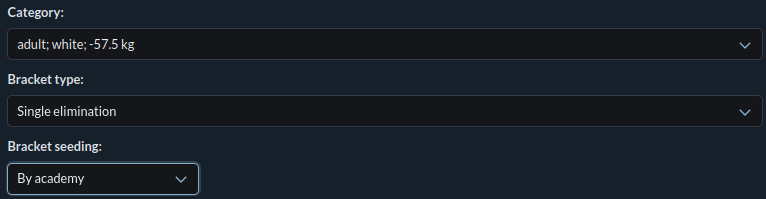
Each competitor registered for the competition is assigned to an academy. It often happens that in one weight category there are several competitors from the same academy. In this case, the bracket generator will arrange the brackets so that competitors from the same academy meet as late as possible.
ℹ️ Important: Competitors, to be properly seeded in the bracket, must represent the same academy, i.e. they must have the same academy identifier. The system distinguishes between academies with different identifiers, even if they have the same name. For example, if one competitor registered under the academy ABC and another competitor duplicated the same academy in the system, technically they will be two different academies.
By assigned spot
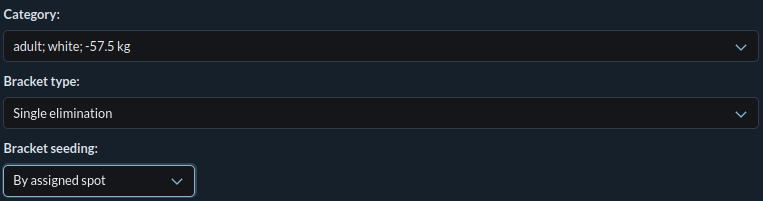
If we organize wrestling competitions, we can additionally, during the verification of competitors, assign each competitor a spot — e.g. by drawing lots.
Then, when the system generates brackets, it will seed competitors according to the assigned spot. I.e. competitors who drew numbers 1 and 2 will meet in the first match.
In a situation where we partially draw and assign spots to several competitors, and the rest of the category will not have assigned spots. The system will take into account the order of registration.
- For example, having 8 competitors in the category, we assign spots only to three: 1, 2, 8.
- The remaining 5 competitors do not have assigned spots.
- The system will arrange the bracket, first selecting competitors with assigned spots: [1, 2, 8] and then the remaining competitors in the order in which they were registered for the competition.
- So, even though the third competitor has chosen number 8, he will be placed in the 3rd place in the bracket.